

Was Akatsuki Legion’s report a paid smear against CheatSeller? Review the REVSTEALER claim, JPEG hashes, refusal to retract and four corrected assessments.
Akatsuki Legion publicly branded CheatSeller a “primary distribution hub” for REVSTEALER without presenting a reproducible chain showing that this malware was delivered from our domain. Its November 9, 2026 report on akatsukilegion[.]com named cheatseller[.]com a Primary distribution hub and included it in a list of indicators of compromise. That is not a harmless research hypothesis: such wording can undermine customer trust and influence domain-reputation assessments.
We consider this attribution false, damaging and presented with a level of certainty the disclosed evidence does not justify. The public domain-specific connection relies heavily on publicly accessible product artwork. When we demonstrated that two key SHA-256 values identify ordinary JPEGs, Akatsuki Legion acknowledged it in writing — and still refused to remove the listing. Below we publish the relevant statements, evidence and technical rebuttal.
Could this have been a commissioned reputational attack? We are asking that question directly. CheatSeller operates in a competitive search market and, in our assessment, has meaningful visibility for commercial queries. After the November 9 publication, we observed adverse domain assessments; four organizations subsequently reviewed and corrected their positions following our appeals. Timing alone does not establish that the report caused every classification. But the seriousness of the allegation, the gaps in the public attribution and the refusal to correct it raise legitimate questions about possible commercial interests behind the publication. We have no evidence that this particular report was paid for, and we do not present that suspicion as a proven fact.
What this investigation demonstrates: how ordinary JPEGs became an argument about allegedly shared malicious infrastructure; why a third-party file contacting a website does not establish operator involvement; how Akatsuki Legion responded to specific objections; and how four negative domain assessments changed following review. This is not a plea for leniency. It is a demand for accountability for public allegations capable of damaging a business.
1. How Akatsuki Legion labelled CheatSeller a malware distribution hub
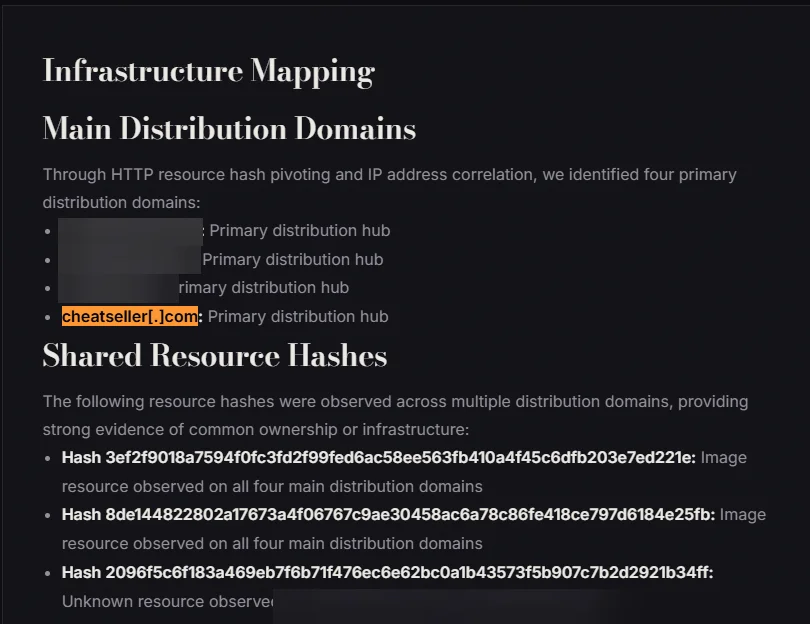
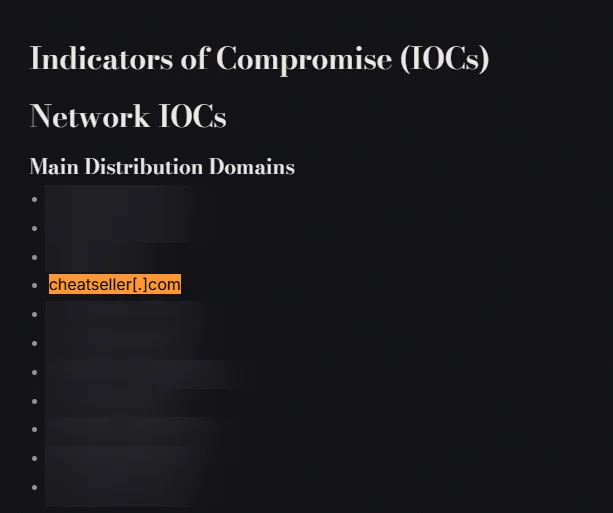
Akatsuki Legion’s November 9 publication, “Inside REVSTEALER’s Growing Distribution Ecosystem,” is hosted at akatsukilegion[.]com. In its infrastructure section, it classifies CheatSeller as a primary malware-distribution domain. The stated investigative methods include HTTP resource hash pivoting and IP correlation. For CheatSeller specifically, the readily identifiable public evidence centers on two shared image resources.
Excerpt from the public report · November 9, 2026
“cheatseller[.]com: Primary distribution hub”
Akatsuki Legion published this as an asserted finding, not as a tentative lead. The label primary distribution hub carries a concrete implication: that the named website is used to distribute malicious software. It is more consequential than describing a potential lead, a shared file, or a website operating in the same general market.
Three propositions must be kept distinct: (1) two sites contain identical content; (2) they are controlled by the same operator; and (3) that operator delivers a particular malware family. Evidence supporting the first proposition is not automatically evidence supporting the other two.
2. Two ordinary JPEGs at the heart of a sweeping accusation — admitted by Akatsuki Legion

On November 13, 2026, CheatSeller supplied Akatsuki Legion with the reported file paths, formats, dimensions, and filesystem creation timestamps for the two resources. Both were described as product artwork under the December 2024 upload directory.
| Resource | SHA-256 | Metadata provided by CheatSeller |
|---|---|---|
| DayZ category artwork | 3ef2f9018a7594f0fc3fd2f99fed6ac58ee563fb410a4f45c6dfb203e7ed221e |
JPEG, 381 × 434 px; uploads/202412/phpteka8e_split_dayz_cheats.jpg; filesystem creation: December 31, 2024, 16:22:39 (UTC+3). |
| Escape from Tarkov category artwork | 8de144822802a17673a4f06767c9ae30458ac6a78c86fe418ce797d6184e25fb |
JPEG, 381 × 434 px; uploads/202412/phpwm92zn_split_escape_from_tarkov.jpg; filesystem creation: December 31, 2024, 15:18:31 (UTC+3). |
A filesystem creation timestamp is not, by itself, cryptographic proof of when an image first appeared online. That limitation should be acknowledged. The decisive analytical point here is the nature of the identified resources: they are images, not demonstrated REVSTEALER payloads.
Excerpt from Akatsuki Legion’s email response · November 16, 2026
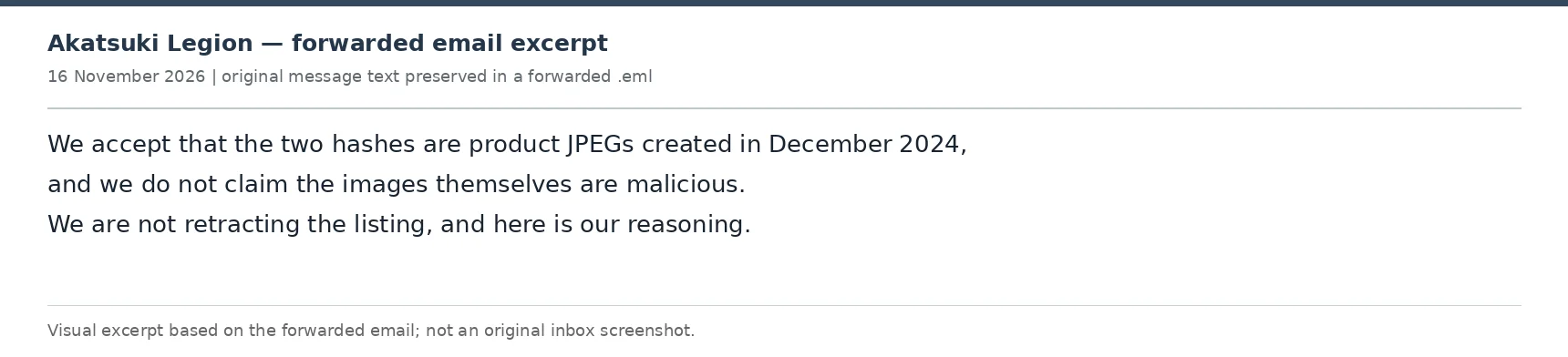
“We accept that the two hashes are product JPEGs created in December 2024”
SHA-256 is a cryptographic digest of file bytes. It is not a signature proving the identity of a website owner, an image creator, or the person who copied a file. If an image can be downloaded by any visitor, the same bytes can be republished elsewhere without the original site’s permission or knowledge.
Turning the hashes of ordinary JPEGs into a criminal-infrastructure narrative is rhetorically striking but logically incomplete. A hash proves file identity, not who owns a domain or distributes malware. We consider this leap a serious methodological failure.
Bottom line: matching JPEG hashes are a legitimate starting point for investigation, not standalone proof of common administration, coordinated operations, or malware distribution.
3. Where Akatsuki Legion confused correlation with attribution
HTTP resource hash pivoting is a useful discovery technique: it can identify multiple sites hosting the same resource. But the possible explanations include copied product artwork, a common media source, templated layouts, and deliberate impersonation. None is equivalent to establishing a single business owner or malicious operator.
The inferential gaps in the disputed claim
Matching image SHA-256 → hypothesis of common control → allegation of REVSTEALER distribution. Every step requires independent evidence; identical images cannot supply that evidence on their own.
Likewise, sharing an IP address is not automatically evidence of common administrative control. Shared hosting, reverse proxies, and CDNs can produce overlapping network infrastructure. Strong attribution requires independently corroborated signals: historical DNS relationships, consistent administrative fingerprints, infrastructure control, verified download chains, and malware-delivery telemetry.
Notably, the report’s published IP-cluster subsection lists other domain clusters without presenting a standalone, reproducible IP-based control chain for cheatseller.com. This does not prove that no other connections exist. It means the public material does not visibly substantiate the level of confidence expressed for CheatSeller on this point.
Commercial similarity is also a weak attribution signal. Malicious actors may advertise fraudulent game tools, but that does not mean every commercial gaming-software website is part of a particular stealer campaign. An attribution must be established for the site in question, not inferred from the category of products it sells.
4. Later claims about third-party executables do not establish REVSTEALER delivery
In its November 16 response, Akatsuki Legion added claims about archives and executables that allegedly refer to CheatSeller or contact its domains. This is an important distinction: actual network traffic, when correctly documented, is more specific than an image-hash match. It deserves investigation, not dismissal.
| Allegation | What appropriate telemetry could establish | What remains unproven without more data |
|---|---|---|
An unofficial archive bearing the CheatSeller name reportedly fetched three utilities from /uploads/. |
A timestamped request, and—if a successful response with matching bytes was captured—delivery of specified files from the recorded host at that time. | Who created the archive, whether the utilities were malicious, the site operator’s knowledge, and whether any returned bytes contained REVSTEALER. |
Another executable reportedly contacted cheatseller.com and cheatseller.ru. |
Observed network activity associated with that executable, if the capture can be reproduced and authenticated. | That CheatSeller created, signed, authorized, or distributed the executable; or that the connection delivered a stealer payload. |
| Other files reportedly produced multiple security detections or contained the domain name. | Reason to inspect the samples on their own merits. | Provenance of those files or actual operation of CheatSeller as a REVSTEALER distribution hub. |
This is where the central sleight of hand occurs. Observing a file contact a public website does not prove that the website operator authored, distributed or endorsed that file. Even an alleged utility download must be supported by actual network artifacts and verification of what was delivered. “A sample contacted this site” cannot quietly become “this site distributed REVSTEALER.”
CheatSeller requested the exact URLs of the alleged downloads, timestamps, HTTP status codes, response-body evidence, the SHA-256 values of transferred files, and the chain allegedly connecting them to REVSTEALER. The correspondence provided to us does not contain those reproducible artifacts. Without them, a network request cannot substantiate the claim that CheatSeller distributed REVSTEALER.
CheatSeller did not create or distribute the third-party archives or executables cited by the authors. A matching name or a third-party program contacting a public address is not evidence to the contrary.
5. Four corrected assessments: domain warnings are not proof of Akatsuki Legion’s claim
Documented reconsideration of the domain assessments (anonymized crops of original email screenshots):

Reply 1: a review was completed, the detection was removed, and the URL was classified as not detected.

Reply 2: an analyst confirmed that the negative assessment was being corrected after CheatSeller's response.

Reply 3: the URL was confirmed to be no longer blocked.

Reply 4: a subsequent assessment described the site as a legitimate online platform and found insufficient evidence to classify the domain itself as malicious. Reviewer identities and operational details are omitted from the public excerpts; CheatSeller retains the originals.
Akatsuki Legion also cited prior negative domain classifications in its November 16 email. Reputation signals can be useful for triage, but they are not self-explanatory. If multiple assessments derive from the same original claim, counting them as independent confirmations would introduce an attribution loop.
Following CheatSeller’s appeals, four independent security reviewers revisited their negative assessments of cheatseller.com. The replies document the removal of detections, correction of an adverse assessment, and the absence of a continuing block. One reviewer explicitly confirmed that the website is a legitimate online platform and that insufficient evidence had been found to classify the domain itself as malicious. These are concrete outcomes from subsequent reviews, not merely “favorable feedback.”
That directly weakens Akatsuki Legion’s “independent flags” argument. When the assessments cited by an accuser are corrected following review, they cannot reasonably remain unquestioned proof of its allegation. Repeating a reputation label does not convert it into primary evidence of malicious distribution.
Akatsuki Legion invoked earlier negative classifications to reinforce its claims, yet the subsequent domain reviews changed those assessments. Presenting outdated warnings as independent proof that CheatSeller distributed REVSTEALER is methodologically unsound. Reputation labels cannot substitute for primary, reproducible evidence.
The risk of circular reporting is straightforward: an initial unverified allegation is repeated by a scoring system, and the resulting score is later offered as independent proof of the initial allegation. That risk calls for provenance checks. We are not claiming that every previous warning in this case was caused by such a cycle.
6. Akatsuki Legion acknowledged the JPEGs yet refused to remove CheatSeller
- November 9, 2026: Akatsuki Legion published the REVSTEALER report, naming CheatSeller among its primary distribution domains.
- November 13: CheatSeller shared metadata concerning the two JPEG resources and requested direct evidence of malware downloads from our domain.
- November 16: Akatsuki Legion acknowledged that the two hashes identify product JPEGs, declined to retract the listing, and advanced additional arguments about shared resources, third-party files, and former domain warnings.
- November 17: CheatSeller sent a detailed rebuttal requesting exact URLs, timestamps, HTTP evidence, independent proof of common control, and a direct REVSTEALER distribution chain.
Akatsuki Legion's own words document its refusal: having acknowledged that the two resources were product images, the authors wrote, “We are not retracting the listing.” This is a direct statement from their November 16 reply, not CheatSeller's interpretation.
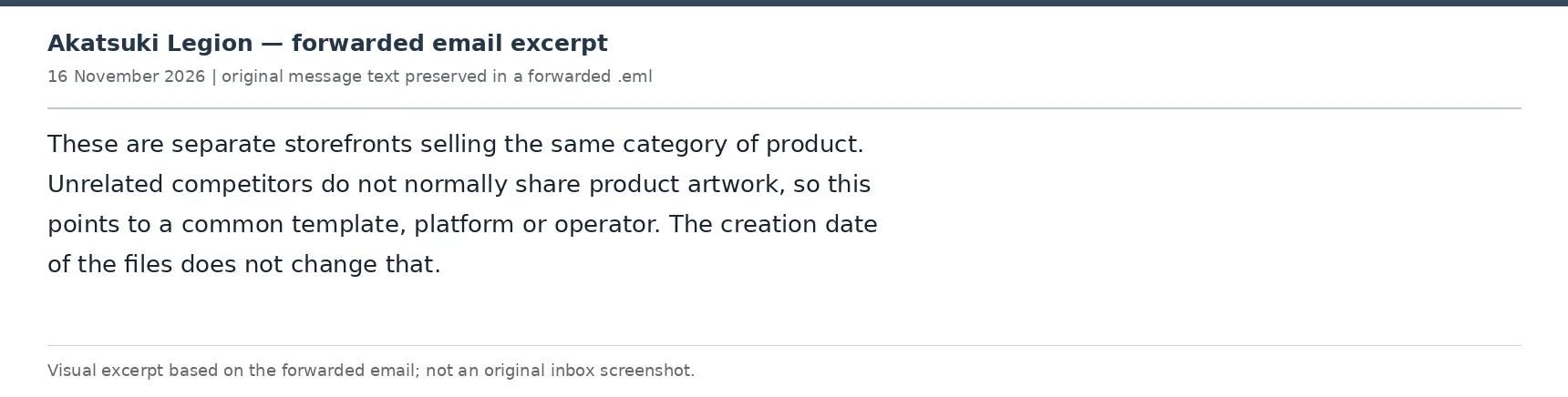
How does Akatsuki Legion justify its refusal? The authors argue that unrelated storefronts would not usually use the same product images, and suggest a common template, platform or operator. Yet publicly accessible product images can be copied. The formulation “common template, platform or operator” itself describes alternative explanations rather than establishing shared ownership, let alone actual REVSTEALER distribution.
The authors continued to express “high confidence” that the domain formed part of malicious distribution infrastructure. The issue is not whether further investigation is permissible, but whether the domain-specific evidence made available supports such a categorical public accusation.
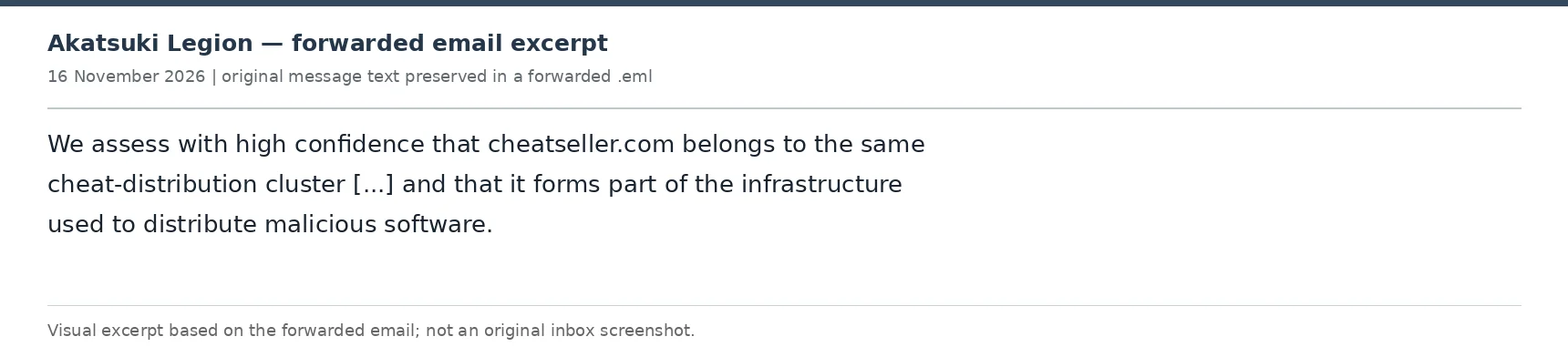
At the time of publication, we are not aware of a public technical response resolving those domain-specific requests. If verifiable new evidence emerges, we will evaluate it and update this article with a dated correction where warranted.
7. Akatsuki Legion’s “high confidence” cannot replace a documented delivery chain
Akatsuki Legion described its conclusion about CheatSeller as high confidence. The credibility of that phrase depends not on the number of suspicious-looking observations, but on the strength of the causal chain. A reproducible domain-specific claim should ideally include:
- a concrete malware sample with an authenticated SHA-256 and defensible linkage to REVSTEALER;
- the exact download endpoint on the named domain, timestamp, HTTP result, and cryptographic hash of the returned bytes;
- verified redirect history and provenance of the relevant traffic capture;
- independent evidence of administrative control when shared ownership is alleged;
- a discussion of alternative explanations, including image reuse, unrelated executables, and third-party brand impersonation;
- a process for correcting an attribution when a material indicator receives a benign explanation.
We are not rejecting every component of Akatsuki Legion’s REVSTEALER research. We are challenging a narrower and more consequential inference: the step from a broad malware ecosystem to a specific accusation against cheatseller.com.
8. Akatsuki Legion’s claims tested: evidence versus speculation
| Claim | What the available record supports | Assessment |
|---|---|---|
| Shared images show one operator. | Two matching JPEGs are acknowledged; control of the other sites is not established by the images. | Insufficient for ownership attribution. |
| The website’s product category links it to REVSTEALER. | Commercial similarity does not demonstrate the distribution of a specific malicious sample. | A direct delivery chain is needed. |
| IP correlation connects the infrastructure. | The visible IP-cluster subsection does not show a reproducible, CheatSeller-specific control chain. | Not substantiated in the relevant public section. |
| Third-party files refer to or contact CheatSeller. | The group asserts these observations; a full attribution requires the underlying traffic and file artifacts. | Investigative leads, not proof of authorship or REVSTEALER delivery. |
| Earlier domain warnings establish maliciousness. | Four follow-up reviews resulted in removed or corrected adverse assessments and confirmation of non-blocking status. | Earlier warnings are not proof of the allegation, and the assessments changed. |
9. Akatsuki Legion: a commissioned hit piece, conflict of interest or failed investigation?
Who benefits when a commercial website is branded a “primary hub” for an infostealer? In a competitive market, such a claim can be a convenient way to damage a reputation: discourage customers, trigger negative assessments and force the targeted business to spend time on a rebuttal. CheatSeller regards a commercially motivated attack as one hypothesis worth examining — especially after Akatsuki Legion acknowledged the JPEG issue yet kept the original designation.
In our view, Akatsuki Legion’s handling of CheatSeller resembles reputational discrediting dressed up as technical attribution. A categorical accusation appears; ordinary product images become an asserted infrastructure link; additional references to unrelated files and older warnings follow the rebuttal; yet the Primary distribution hub label remains unchanged. We are not required to accept this as rigorous independent research merely because it uses the vocabulary of threat intelligence.
Akatsuki Legion publicly provides information about sponsorship. That fact alone says nothing about who, if anyone, funded this report. It is not evidence of a commissioned article. But if the authors seek trust as independent researchers, they can answer: Was there a client for this story? Did anyone offer compensation to include a specific domain? Were there relevant conflicts of interest? Who reviewed the CheatSeller-specific attribution before publication?
We are not claiming to have proven a paid commission: we have no payment records or evidence of instructions from a third party. What we do have are specific reasons to challenge the public attribution and demand an explanation. Questioning editorial independence is legitimate; inventing secret payments is not. We invite Akatsuki Legion to respond publicly and to produce direct technical evidence if it exists.
Can Akatsuki Legion be trusted on CheatSeller?
Not as a source establishing that CheatSeller distributed REVSTEALER. The domain-specific materials disclosed to us do not establish a reproducible malware delivery chain; two central shared indicators are ordinary JPEGs, as the authors themselves acknowledged. Readers and security analysts should not repeat Akatsuki Legion’s accusation as a proven fact.
Why did Akatsuki Legion refuse to remove CheatSeller?
In its November 16 email, the group wrote: “We are not retracting the listing.” It cited reused images, the category of the websites, third-party executables and earlier negative assessments. These may provide investigative leads, but they do not disclose a direct, reproducible chain establishing REVSTEALER delivery from cheatseller.com.
Could Akatsuki Legion’s article have been commissioned?
CheatSeller considers this a possibility because the publication can cause concrete reputational damage and retains a categorical allegation despite a disputed evidentiary basis. But payment, a client’s instructions and deliberate deception have not been established by the documents available to us. We demand transparent disclosure of relevant editorial interests and substantiation of the claim.
What do the image hashes and corrected assessments actually establish?
The hashes demonstrate identical JPEG bytes, not common ownership or malware delivery. Four later replies document corrections to adverse domain assessments. Together, these facts materially weaken Akatsuki Legion’s confidence claim about CheatSeller; each remaining technical allegation must still be evaluated on its own merits.
10. Verdict: Akatsuki Legion damaged CheatSeller’s reputation with an attribution it has not substantiated
Our conclusion is unequivocal: Akatsuki Legion’s article is not a trustworthy evidentiary basis for its claims about CheatSeller. The group publicly labelled our domain a Primary distribution hub for REVSTEALER and placed it among suspicious infrastructure. Yet two concrete hashes it relied on to connect the websites refer to ordinary product JPEGs. Akatsuki Legion admitted this, then refused to amend the listing.
This is not a minor technical typo. It is a damaging public accusation built on a leap from matching content to alleged malicious activity. Instead of showing a reproducible delivery of REVSTEALER from our domain, readers are offered image hashes, category similarities, assertions about third-party files and earlier reputation warnings. Each item has a clear boundary between an investigative lead and proof of malware distribution. Akatsuki Legion did not respect that boundary in its categorical description of CheatSeller.
Four subsequent corrections to adverse domain assessments show that earlier labels were not incontestable proof of the accusation. One review expressly found that the website was a legitimate online platform and that there was insufficient evidence to classify the domain itself as malicious. These are documented results of separate reviews, not merely favourable public relations, and they stand in stark contrast to Akatsuki Legion’s confident rhetoric.
That is why we publicly ask: could Akatsuki Legion’s article have been part of a commercially motivated attack on a business operating in a competitive market? This possibility requires proof and must not be presented as established. But a categorical accusation, weak disclosed grounds, reputational consequences and a persistent refusal to correct the designation make questions about motive and editorial independence unavoidable.
In our view, Akatsuki Legion has demonstrated an irresponsible and misleading approach to attributing malicious infrastructure to CheatSeller. We consider the allegation about our involvement in REVSTEALER distribution false and harmful to our business reputation. Impressive technical terminology, IOC tables and the words “high confidence” cannot fill the evidentiary gap. Researchers making serious public accusations must answer with verifiable facts, not reputational labels.
Akatsuki Legion has a choice: provide a specific URL, a documented download event and timestamp from cheatseller.com, a verifiable hash of the delivered payload and a demonstrable connection to REVSTEALER — or correct the claims and remove CheatSeller from the accusatory list. Until then, relying on the report as established proof of malicious activity by CheatSeller risks repeating an unverified and damaging allegation.
CheatSeller denies any role in the REVSTEALER distribution infrastructure and demands a public correction from Akatsuki Legion. A business’s reputation is not expendable material for a sensational “investigation.” If Akatsuki Legion wants to be regarded as an independent research group, it must demonstrate independence through reproducible evidence and a willingness to correct errors.
Sources used for this response: Akatsuki Legion’s November 9, 2026 article, correspondence with the authors from November 13–17 and replies from four reviewing organizations. Statements about internal infrastructure checks are CheatSeller’s account; a possible commercial motive remains a question, not an established fact.
You will need to complete all the items listed here:
PC preparation
If you have any difficulties or questions, please contact
our support team
You can follow all our news and updates in
our Telegram channel