

Arctic Cheats reviews investigated: Trustpilot removed fake reviews and withheld its rating. Review timelines, misleading comparisons and CheatSeller facts.
Arctic Cheats Exposed: Fake Reviews Removed, Misleading Ratings and the Attack on CheatSeller
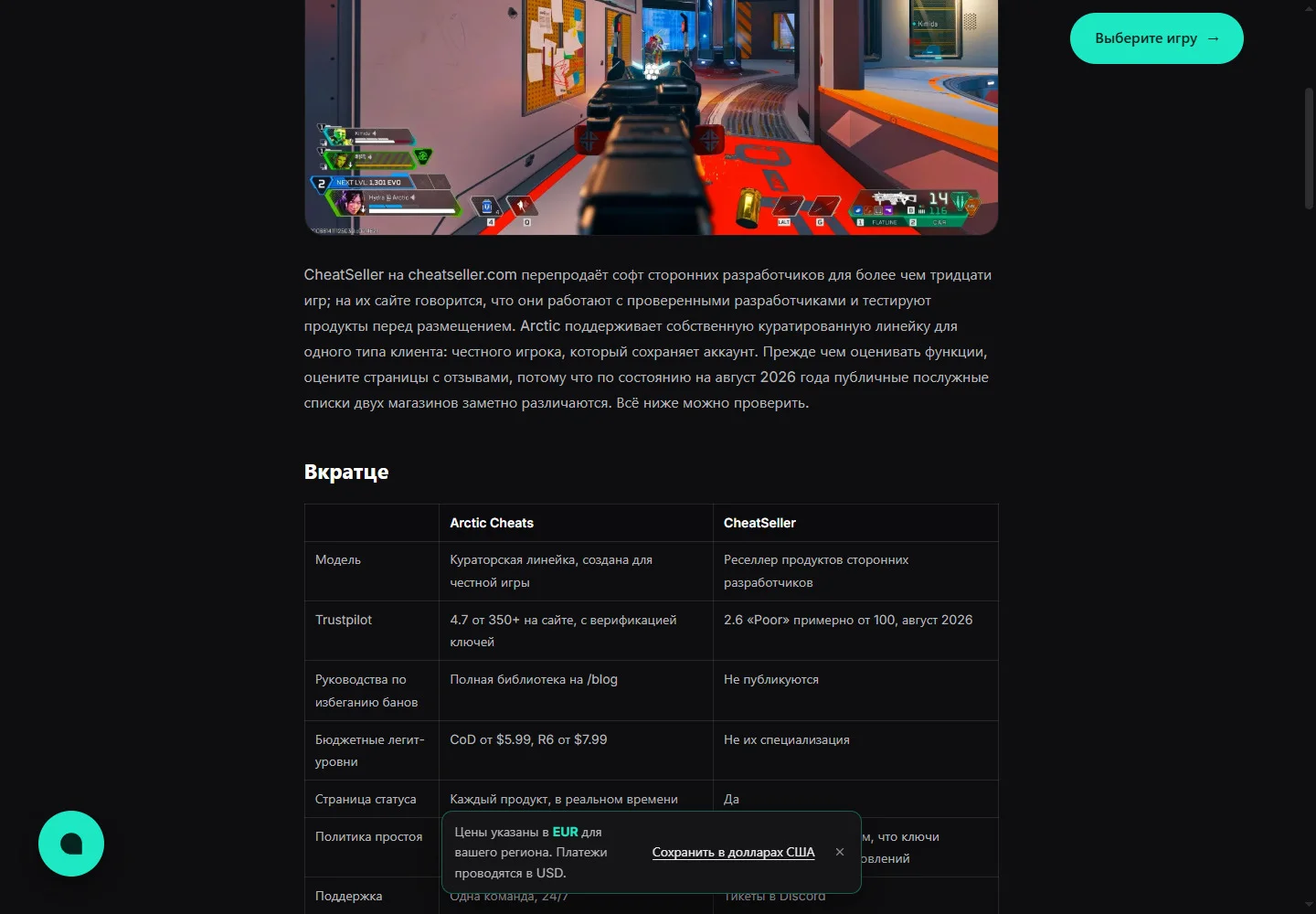
Arctic Cheats published a commercially interested attack on CheatSeller while presenting itself as the more trustworthy merchant. Yet the independent record raises serious questions about Arctic Cheats itself: Trustpilot says it removed fake reviews associated with the company and has made its overall rating unavailable following a breach of platform guidelines. Meanwhile, Arctic Cheats promotes a 4.7/5 score on its own website and uses that score in a comparison designed to make CheatSeller look inferior. That is not a comparison readers should accept without scrutiny.
On August 25, 2026, arcticcheats[.]wtf published a piece targeting searches for the CheatSeller brand. It presents itself as a helpful comparison, but it is written by a direct seller competing for the same buyers. Its favorable verdict points readers back to the publisher's own products. Advertising claims, anecdotes and numbers from different sources are blended together as though they were equivalent evidence.
We reject the premise that this is an independent assessment of the market. Below is a documented examination of the evidence: what Arctic Cheats actually published, what an independent review platform now reports, how Arctic Cheats controls its on-site reviews, and why CheatSeller should be judged on the real services it offers. Public pages were checked on November 17, 2026; the article's August snapshot and the later platform notice are not treated as simultaneous events.
A closer look at dates found at least five five-star reviews on September 6, 2025, and six consecutively published one-star reviews in October–November 2026. Trustpilot also contains allegations of pressure for positive feedback to which Arctic Cheats publicly replied. The timeline below separates observable facts from claims and inferences.
This is more than a disagreement between merchants: Arctic Cheats uses a competitor brand to promote itself while an independent platform reports removed fake reviews associated with Arctic Cheats.
1. Arctic Cheats exposed by its own Trustpilot warning
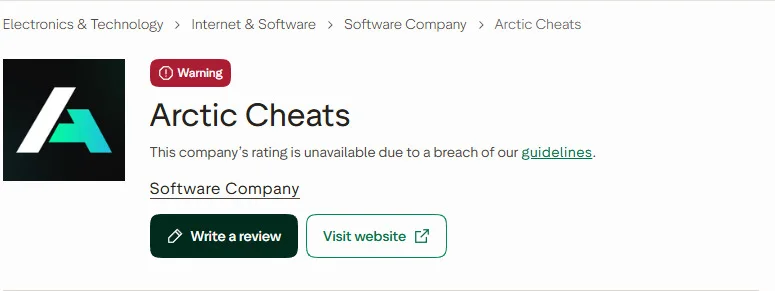
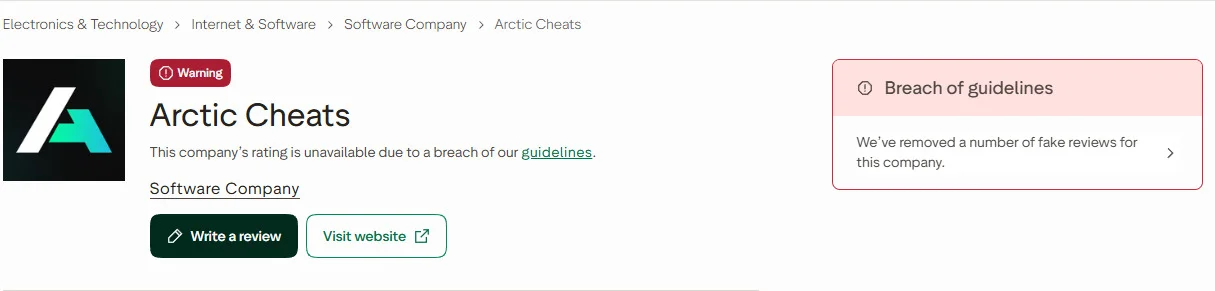
Trustpilot's public profile for Arctic Cheats displays a warning that the company's overall rating is unavailable due to a breach of its guidelines. It also states that a number of fake reviews for the company have been removed. This is not a claim invented by CheatSeller, an anonymous accusation or a competitor's opinion. It is a notice published by an independent review platform on Arctic Cheats' own profile.
The two key statements are clear: “This company’s rating is unavailable due to a breach of our guidelines” and “We’ve removed a number of fake reviews for this company.” Those statements establish that the platform reported a guidelines breach and removed fake reviews. They do not identify who posted those reviews, and we do not pretend otherwise.
But the confirmed facts already raise a serious question: why should a business whose independent rating is withheld over a rules breach act as an authority on another store's reputation while marketing its own 4.7 score as proof of superiority?
2. A misleading Trustpilot comparison built around Arctic Cheats’ own score
The Arctic Cheats comparison includes a row labeled “Trustpilot.” For CheatSeller, it references a third-party rating. For Arctic Cheats, that same row promotes “4.7 from 350+ on-site, key-verified”. The crucial qualifier is “on-site.” This is not Arctic Cheats' rating on Trustpilot. It is a score generated on Arctic Cheats' own website.
Different sources do not become comparable just because they appear in one table row. An in-house review page and an independent review platform operate under different submission, moderation and appeal systems. Even if every review on a seller's own site is tied to a purchase, that does not make it independently operated.
| Question | Arctic Cheats' approach | Why it matters |
|---|---|---|
| Row label | “Trustpilot” | Suggests like-for-like data from one source |
| Arctic Cheats score | 4.7/5 from its own site | Different source and moderation system |
| Competitor score | From an independent platform | Not a methodologically equivalent comparison |
| Arctic Cheats' independent rating today | Unavailable after a guidelines breach | Material context for claims of reputational superiority |
An honest comparison would use the same review platform over the same period, or visibly separate in-house metrics from third-party ratings. Arctic Cheats placed the two figures side by side instead. That is not proof of a better reputation; it is misleading presentation of non-equivalent data.
3. Who moderates Arctic Cheats reviews? Arctic Cheats itself
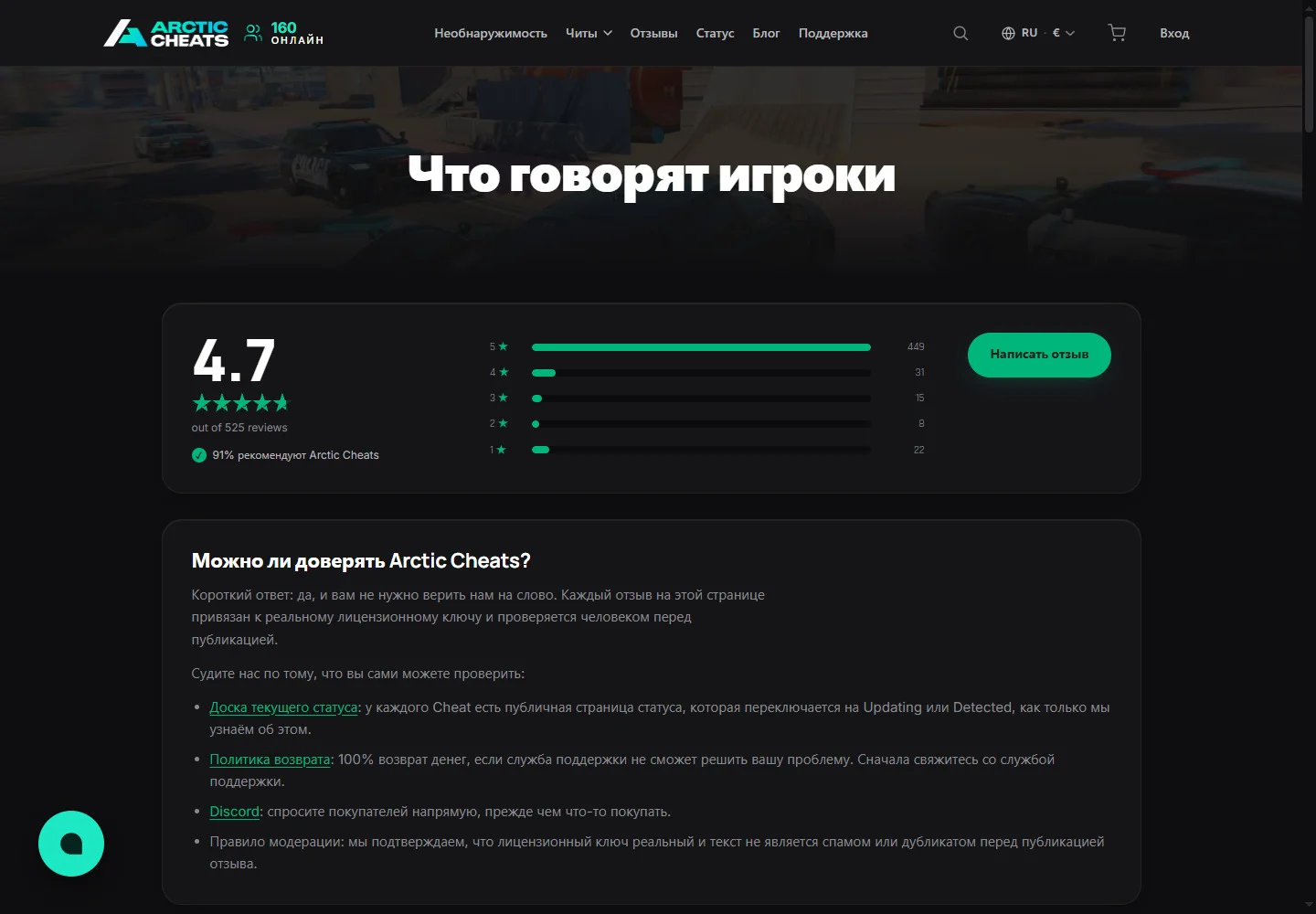
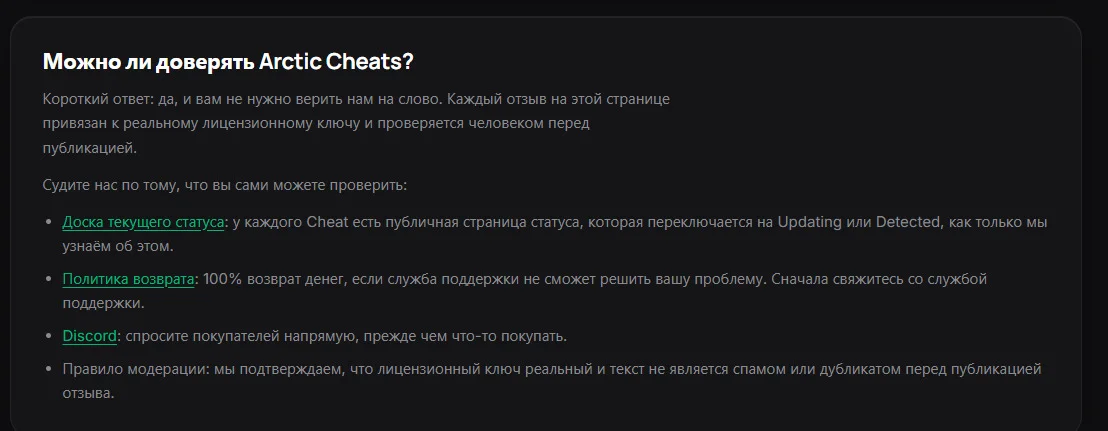
Arctic Cheats emphasizes that its on-site reviews are linked to license keys. On the same review page, it openly describes its moderation rule: it checks that the key is valid and the text is not spam or a duplicate before publishing the review. In other words, Arctic Cheats controls the gatekeeping process for reviews displayed on its own platform.
Verifying a purchase can help limit spam. But it does not answer other questions: who independently audits rejected submissions? What process protects legitimate critical reviews? Can the public examine the complete record of moderated posts? The mere existence of moderation does not prove negative reviews are censored. It establishes that publication decisions remain inside a system controlled by the interested seller.
That distinction matters even more when the company's independent profile carries a fake-review removal notice. A “key-verified” label is not a substitute for independent scrutiny. If a business places its own score at the center of a reputational attack on a competitor, it should explain the methodology rather than ask readers to trust a flattering number.
Arctic Cheats' on-site rating versus independent review distribution: a measurable gap
The numbers are more revealing than any marketing slogan. Arctic Cheats displays 525 on-site reviews: 449 five-star and 22 one-star. That is approximately 85.5% top ratings and 4.2% lowest ratings. Trustpilot shows 436 reviews, with 54% five-star and 39% one-star. These are different datasets; the divergence alone does not prove that Arctic Cheats suppressed negative reviews. It does, however, make an on-site 4.7/5 score a particularly poor substitute for independent reputation evidence.
| Metric | Arctic Cheats' own website | Trustpilot profile for Arctic Cheats |
|---|---|---|
| Published reviews | 525 | 436 |
| Five-star share | 449 (85.5%) | 54% |
| One-star share | 22 (4.2%) | 39% |
| Publication control | Arctic Cheats checks reviews before publication | Independent platform with its own rules |
| Overall rating | 4.7/5, self-published | Unavailable after a guidelines breach |
As checked on November 17, 2026, the one-star share differs by approximately 34.8 percentage points and the five-star share by 31.5 points. Different platforms attract different respondents, so the contrast is not proof of selective deletion. It is proof that the two scores should not be passed off as equivalent. Yet Arctic Cheats places its own score in a comparison row labelled “Trustpilot” when discussing CheatSeller.
4. The Arctic Cheats review timeline: five-star bursts versus continuing complaints
Looking beyond the attractive headline scores and examining publication dates makes Arctic Cheats' reputation claims much harder to accept at face value. The visible Trustpilot history contains a concentrated group of five-star reviews in September 2025. Yet one-star reviews did not disappear then or a year later: in autumn 2026, several were published consecutively.
In the publicly accessible sequence from September 2–7, 2025, we identified at least eight five-star reviews, including five published on September 6 alone. Several are brief notes praising particular support staff. A one-day cluster does not establish that reviews were purchased or coordinated. It is, however, a concrete pattern worth scrutinizing when a business presents its review history as proof of exceptional credibility.
The more recent pattern is strikingly different. In the publicly visible sequence from October 14 through November 15, 2026, six consecutively published reviews received one star. Their publication dates were October 14, 25 and 31, and November 2, 8 and 15. These users raised complaints concerning product functionality, assistance, account bans and refund requests. Those are individual customer allegations, not independently verified technical incidents.
| Date / period | Observation in the visible review feed | Why it matters |
|---|---|---|
| September 2–7, 2025 | At least 8 five-star reviews on the reviewed page | A noticeable concentration of favorable ratings |
| September 6, 2025 | At least 5 five-star reviews on one day | A specific, date-verifiable burst |
| October 14 – November 15, 2026 | 6 consecutively published one-star reviews | Serious complaints continued well after the earlier positive cluster |
| November 17, 2026 | 436 reviews, with 54% five-star and 39% one-star according to the displayed breakdown | A highly polarized review profile, not a uniformly positive one |
A 39% share of one-star reviews is not a rounding error or an isolated dissatisfied buyer. It represents a substantial part of the published feedback. Arctic Cheats may dispute individual complaints, but promoting its own 4.7/5 score as a universal measure of trust without disclosing this independent-platform context creates a distorted impression.
This is a reproducible sample from accessible pages, not a complete audit of every historic review. Reviews can be edited and records can be removed, so the visible history may change. We do not claim to have identified every review or which specific submissions Trustpilot removed as fake.
What the dated reviews actually say: complaints hidden by headline ratings
Review-card update timestamps are not the same as original publication dates. The table below uses the initial dates shown beneath the Trustpilot review texts. The issues listed remain individual reviewers' claims, not incidents independently verified by CheatSeller.
| Publication date | Rating | Reviewer's allegation |
|---|---|---|
| Oct 14, 2026 | 1/5 | Game-account restriction following use of a product |
| Oct 25, 2026 | 1/5 | Account ban, support difficulties, and an outstanding refund |
| Oct 31, 2026 | 1/5 | Advertised features allegedly missing or broken, plus a refund issue |
| Nov 2, 2026 | 1/5 | Four hours of troubleshooting followed by an allegedly refused refund |
| Nov 8, 2026 | 1/5 | Software and refund complaints, including a malware allegation by the reviewer—not an independent lab finding |
| Nov 15, 2026 | 1/5 | Account ban and refund complaint |
The September 2025 sequence is also revealing: enthusiastic five-star remarks naming support representatives appeared alongside one-star complaints about functionality, account bans and service during the same week. Even that favorable burst did not mean negative feedback had disappeared. The wider context matters when Arctic Cheats uses a self-reported 4.7/5 rating to assert superiority.
5. Positive reviews demanded for support? What customers alleged
The most troubling aspect of Arctic Cheats' review history is not simply a burst of ratings on one day. Trustpilot also contains dated customer allegations that help was conditioned on leaving positive feedback. That raises a question about how review scores may have been encouraged or influenced.
In a review originally posted on September 12, 2025 and later updated, one author alleged that positive feedback was driven by incentives, contests and requests from staff. On September 25, 2025, another reviewer described an alleged demand for a favorable review before support would be provided. On September 27, 2025, another reviewer made a similar complaint. These are the reviewers' allegations; we are not presenting the underlying incidents as independently established facts.
The company's own public replies are significant. On April 10, 2026, Arctic Cheats responded to these complaints. One reply called conditioning support on a positive review unacceptable; another said the business was addressing concerns about review practices internally. These replies did not include any independent public audit of the disputed review submissions.
The resulting sequence deserves scrutiny: customers allege pressure to leave positive ratings; Arctic Cheats publicly says those practices are unacceptable or being addressed; Trustpilot separately states that it removed fake reviews for this company and withheld its rating. These observations do not prove one coordinated scheme or identify who created the removed reviews. They do, however, provide concrete reasons to question Arctic Cheats' self-reported reputation claims.
Does the timeline alone prove that Arctic Cheats bought a batch of five-star reviews? No. Payment records, origin data or platform findings linking specific accounts would be needed. What is established is that Trustpilot removed fake reviews associated with the company. Combined with identifiable rating clusters, complaints about review pressure and the company's published replies, that is a substantial reason to scrutinize any claim of an unquestionably reliable reputation.
Another notable pattern: a wave of replies to old complaints on one day
A series of Arctic Cheats responses on Trustpilot is dated April 10, 2026, even though the underlying complaints were originally published in September and October 2025. Several negative posts therefore went months without a public reply. Shared reply dates do not establish manipulation; they demonstrate a substantial delay in publicly addressing some older complaints.
There is another contrast in the record. On October 1, 2025, Arctic Cheats replied to two negative reviews by claiming that a dismissed support employee had fabricated them. Those published replies do not contain independently verifiable evidence of that explanation. Later, on April 10, 2026, other company replies describe alleged pressure for positive reviews as unacceptable and say the matter would be addressed internally.
The record therefore does not support simply dismissing every criticism as a competitor's invention. Nor does it prove that Arctic Cheats itself arranged fake reviews. It establishes that the public review history is more complicated than the company's promotional claims about trust.
6. CheatSeller is a functioning multi-product store, not the caricature in a competitor's article
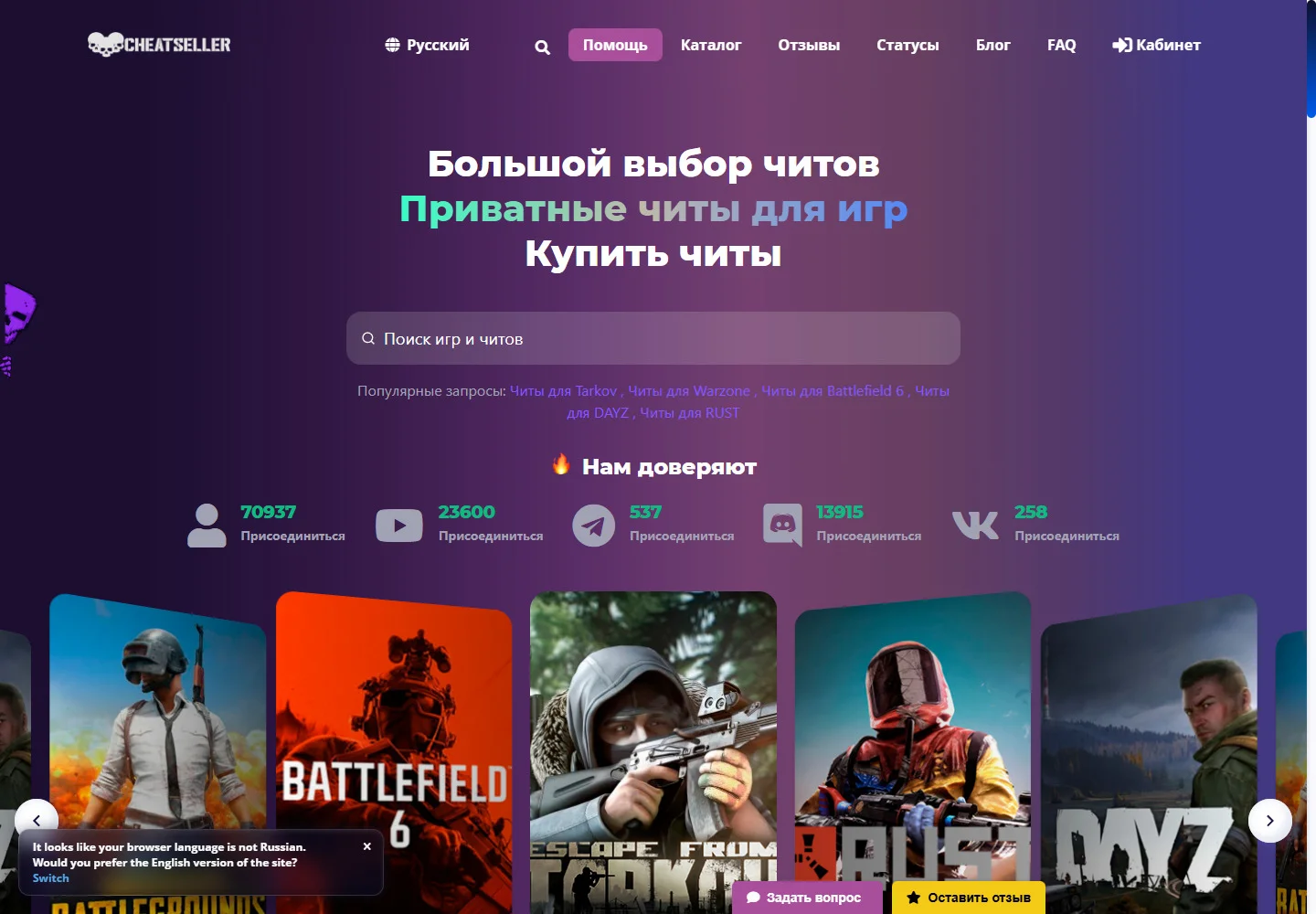
Arctic Cheats tries to frame CheatSeller's reseller model as a defect. The actual CheatSeller platform tells a different story: it is an active specialist storefront with a broad game catalog, dedicated product pages, a public status system, a personal account area, support tools and a help section.
Buyers can choose among games and different software options within a category, considering stated features, operating requirements, compatibility and preferences. That is a meaningful strength of a multi-supplier model. More choice means a buyer is not restricted to one product line or one developer's approach. Working with third-party developers is a normal retail model; its value depends on product selection, useful information and customer service, not on a competitor's label.
CheatSeller lists dozens of game categories, from major competitive titles to niche releases. Dedicated product pages and publicly available statuses help buyers examine published information before purchase. The website also offers help resources, an FAQ and an account area for buyers.
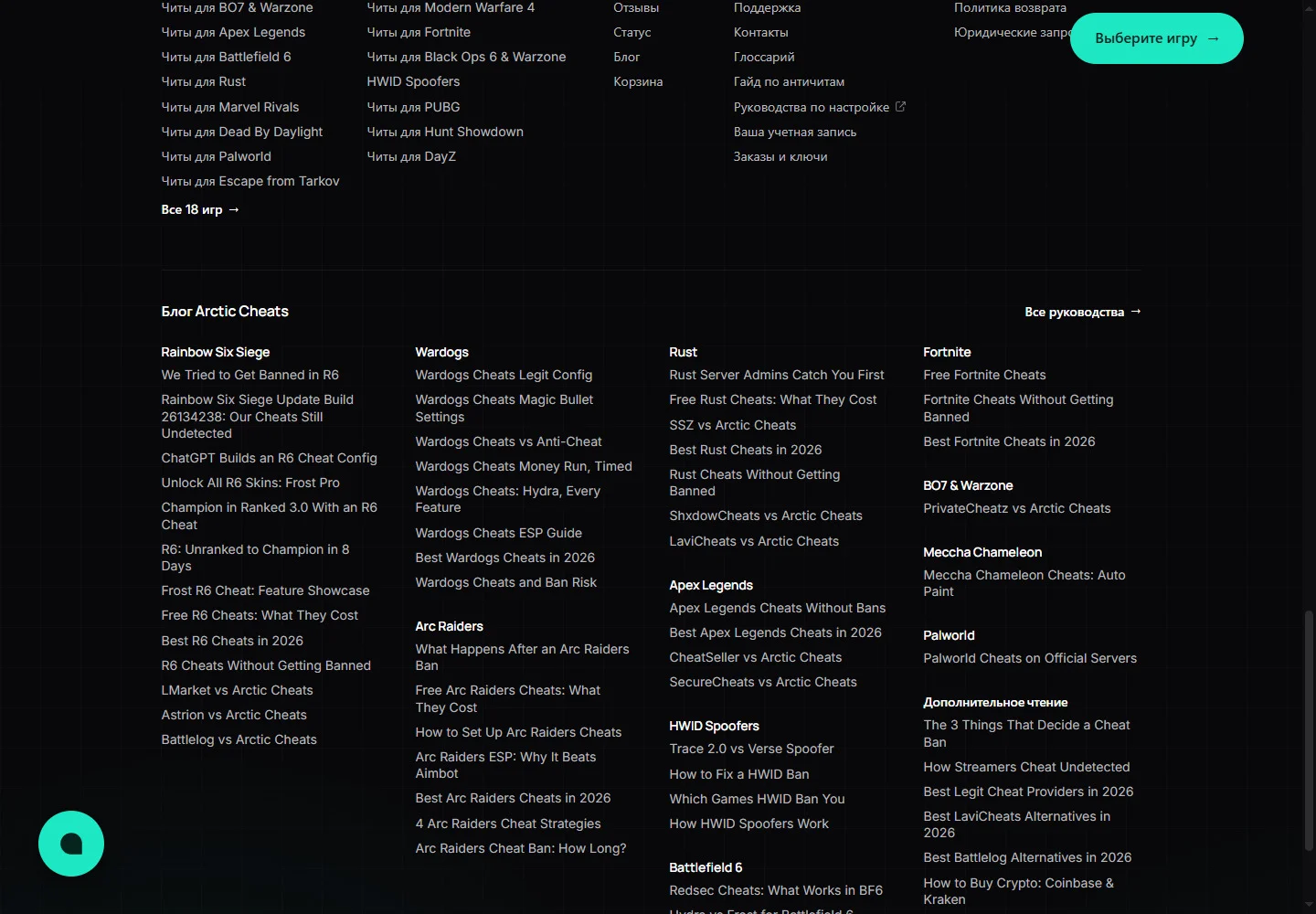
CheatSeller’s breadth is directly visible in its navigation, with more than one hundred game and category entries. Buyers can inspect product pages, browse a searchable catalog, use an account, access instructions and FAQs, contact support, and consult public status updates. These are observable features of an operating service, not unverified claims from a competitor.
7. Status information, support and transparency: what buyers can actually inspect
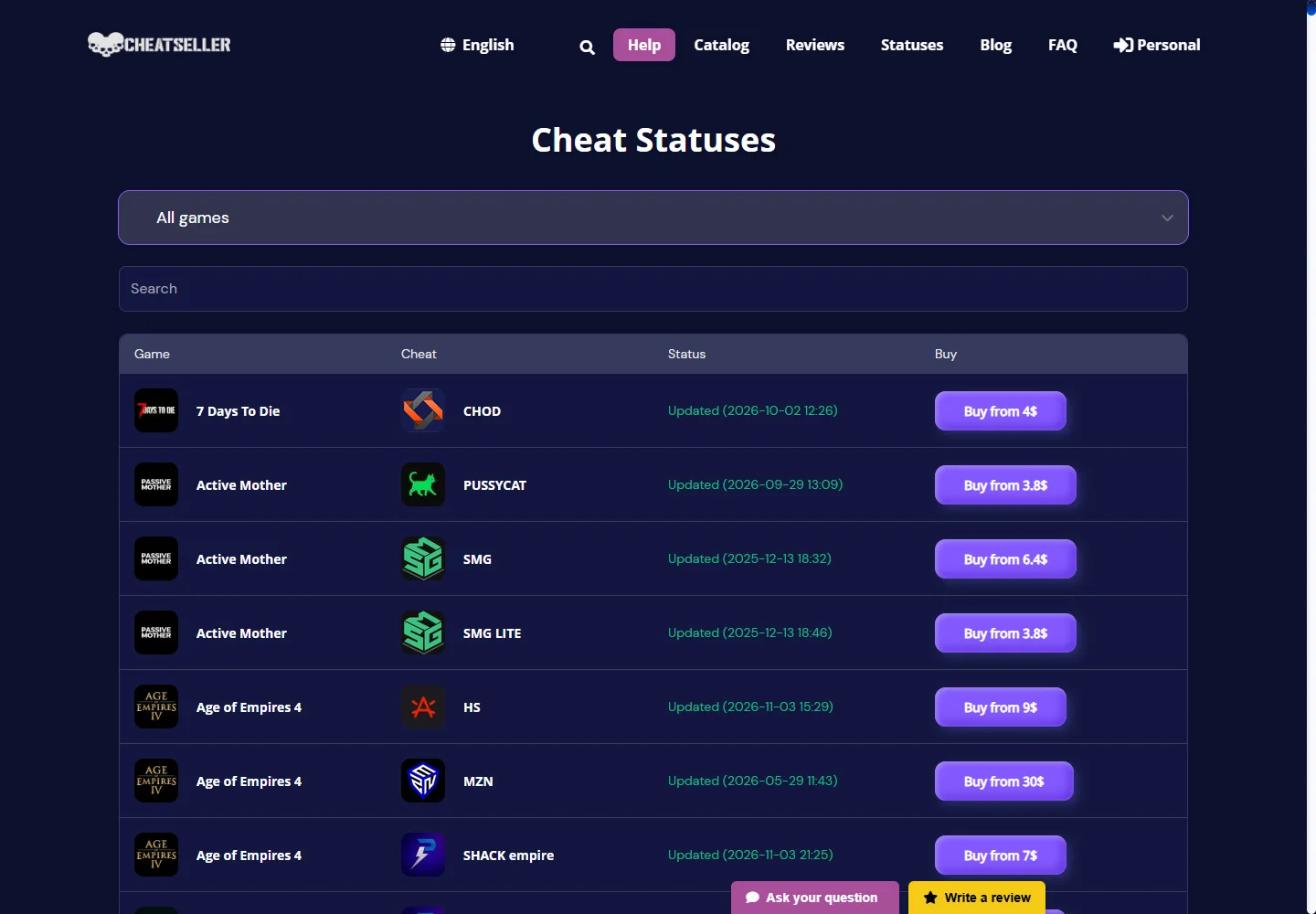
Service quality is a prominent theme in Arctic Cheats' piece. Rather than trust generalizations, readers can check specific CheatSeller tools. The store has a product status section, product specifications, an FAQ and access to support. These are visible customer-facing features, not numbers invented for a comparison chart.
- Public product statuses. Buyers can check published product states and update indicators.
- A catalog with alternatives. Different options let customers choose for their needs rather than conform to a single product.
- Personal account. Buyers have a dedicated area for purchases and associated information.
- Support and FAQ. The website provides instructions and ways to contact technical assistance.
- Pre-purchase information. Product listings allow visitors to review stated features and requirements.
These are sensible ways to evaluate a store: what a buyer can see, verify and use. CheatSeller provides an understandable infrastructure for selection and customer assistance. Claiming that using several developers is inherently inferior, without independently comparing service outcomes, is a marketing argument, not a research finding.
8. The comparison's central flaw: marketing promises instead of one consistent method
Arctic Cheats mixes different types of claims: its own features, promises about service, selected review anecdotes and conclusions about a competitor. Yet it does not present one independent measurement method capable of establishing that one store is categorically more trustworthy than another.
A claim about rapid status updates is not an independently measured resolution time. Having a single support team does not, by itself, measure support quality. Offering products from different developers does not establish poorer customer treatment. Meaningful comparisons require defined criteria, consistent conditions, comparable time frames and limits on the conclusions.
Notice the pattern: Arctic Cheats' own business choices are cast as universal advantages, while CheatSeller's different approach is painted as a universal weakness. When the method seems designed to favor the publisher's store, the result reads like advertising dressed as objectivity.
9. How Arctic Cheats uses competitors' brand searches to promote its own store
This is not one isolated comparison. Arctic Cheats publishes a series of similar pieces contrasting its store with other market participants. The format repeats: a competitor's name in the headline, a favorable comparison table, reasons to choose Arctic Cheats and a path back to Arctic Cheats' products.
That is a familiar form of competitive search marketing. It is not inherently prohibited and does not establish bad faith. It does, however, explain the content's commercial purpose: Arctic Cheats has a direct financial interest in converting readers who searched for CheatSeller into Arctic Cheats customers. That is why the article should not automatically be treated as independent research.
Using competing brands to attract search traffic is one thing. Presenting a sales funnel as an impartial reliability study is another. Arctic Cheats blurs that distinction.
10. Audit of Arctic Cheats' main reputational claims
| Claim or technique | Verifiable fact | CheatSeller's conclusion |
|---|---|---|
| “4.7” used under “Trustpilot” | The number is taken from Arctic Cheats' own website | Two review systems are treated as if they were equivalent |
| Emphasis on “verified” reviews | Arctic Cheats performs pre-publication moderation | Internal gatekeeping is not independent verification |
| Image of reputational superiority | Trustpilot has withheld the rating and reports removed fake reviews | Self-promotional credibility claims need skeptical scrutiny |
| CheatSeller's model depicted as a flaw | CheatSeller has a large catalog, accounts, statuses and support | Multiple suppliers do not themselves establish poor service |
| The comparison positioned as buyer advice | Its author is also a direct competitor and seller | The commercial interest matters when evaluating conclusions |
The clearest evidence against Arctic Cheats' presentation does not come from anonymous attacks. It comes from Arctic Cheats' own table, its own published moderation policy and an official notice from an independent platform. That is a source-based critique, not a demand that readers take our word for it.
11. Are Arctic Cheats reviews and its 4.7/5 rating trustworthy?
Anyone searching for Arctic Cheats reviews, Arctic Cheats Trustpilot, Arctic Cheats fake reviews or Arctic Cheats reputation should separate two questions. What does Arctic Cheats report on its own site? It displays a high score compiled from its in-house reviews. What does the independent platform report? As checked on November 17, 2026, Trustpilot shows a guidelines breach warning and says fake reviews were removed; the company's overall rating is unavailable.
That does not mean every favorable comment about Arctic Cheats is false. It does mean that the self-published 4.7 score cannot be presented as independent proof of reputational superiority — especially when used to steer readers away from CheatSeller.
Customers deserve to know where a rating comes from and who controls its publication. In this comparison, those facts matter more than the marketing language.
12. Why CheatSeller deserves to be assessed on its own merits
CheatSeller does not need to mirror Arctic Cheats' preferred business model to be useful. Its strengths are tangible: wide product choice, organized categories, multiple development options, public statuses, a buyer account area and support resources. Visitors can examine those features directly without relying on a competitor's subjective scorecard.
There is no need to promise the impossible or claim absolute market leadership. The meaningful point is that CheatSeller gives customers options and information rather than insisting that a single store model is the only legitimate one.
CheatSeller is a real, independently operated storefront with its own infrastructure and catalog. Its reputation should be assessed through verifiable information and customer experience, not by a rival's conversion-focused article.
13. Conclusion: Arctic Cheats cannot pass its advertising off as an independent verdict on CheatSeller
The timeline adds an important layer to the central contradiction. Five maximum ratings published on a single day, six consecutive one-star reviews a year later, allegations of demands for positive ratings and the company’s public responses all sit alongside Trustpilot’s official notice about removed fake reviews. We do not claim to know who arranged any such reviews, but brushing aside this record would mean disregarding Arctic Cheats’ own public reputation history.
Arctic Cheats tried to cast itself as the more trustworthy alternative to CheatSeller. The verifiable evidence instead exposes serious weaknesses in that marketing narrative. Its “Trustpilot” comparison features an internal Arctic Cheats rating. Its on-site reviews are moderated before publication by its own system. And Trustpilot withholds the Arctic Cheats rating after a guidelines breach while expressly stating that fake reviews for the company were removed.
Against that background, Arctic Cheats' attempt to grade a competitor's reputation is hard to take seriously. The article does not demonstrate a methodology sufficient to establish an objective ranking of the two stores. It favors the author's business model, combines non-equivalent metrics and directs visitors to the author's products.
Our conclusion is firm: Arctic Cheats' competitor comparisons should not be mistaken for independent research or reliable rankings. Arctic Cheats should clearly separate its internal numbers from third-party assessments, disclose how its scores are produced and correct the misleading elements of its CheatSeller comparison.
For buyers, the better rule is simple: verify the facts, not the volume of the advertising. CheatSeller offers a real catalog, product statuses, support resources and genuine choice among listed programs. Those are concrete points to evaluate — without letting a competitor's marketing campaign define the brand.
FAQ: Arctic Cheats, Trustpilot and CheatSeller
Did Trustpilot remove fake reviews for Arctic Cheats?
Yes. Trustpilot publicly states that it removed a number of fake reviews for the company. The notice does not say who submitted them.
Why is Arctic Cheats' Trustpilot rating unavailable?
The platform cites a breach of its guidelines. As checked on November 17, 2026, Arctic Cheats' overall rating was not displayed.
Is Arctic Cheats' 4.7/5 on-site score an independent rating?
No. It is a score from Arctic Cheats' own website. The company's stated policy includes checking reviews before publication.
Do clustered five-star dates prove Arctic Cheats purchased reviews?
No. At least five five-star reviews in the visible sample were published on September 6, 2025, but clustering alone is not evidence of payment. Separately, Trustpilot confirms that it removed some fake reviews for Arctic Cheats.
Did negative reviews continue after the earlier positive cluster?
Yes. In the accessible timeline, six consecutive one-star reviews were published on October 14, 25 and 31 and November 2, 8 and 15, 2026. Their descriptions are customer allegations, not independently verified technical findings.
What can buyers check at CheatSeller before purchase?
Game and product listings, published specifications, public product statuses, support information, FAQs and the personal account area. Visitors can inspect the available options and customer tools directly.
You will need to complete all the items listed here:
PC preparation
If you have any difficulties or questions, please contact
our support team
You can follow all our news and updates in
our Telegram channel